


Before and after MCH. Conversation with MCH alumni
About the interview format.
This interview was done in a semi-conducted format, asking the participants three questions about their time at MCH and projections. These were delivered in text form for initial editing, and then a group conversation was conducted via video call to establish the connection between the different stories.
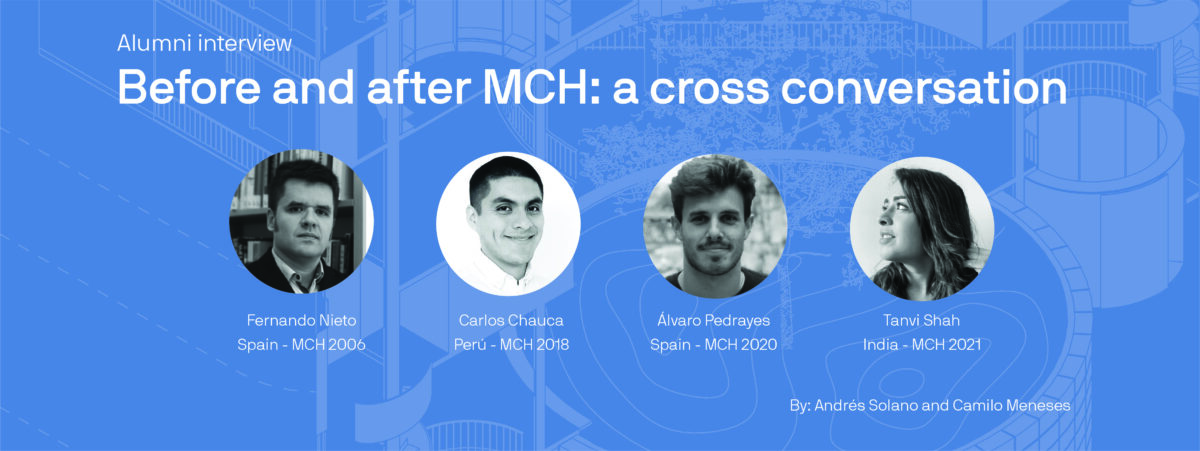
FN: Fernando Nieto – Alumni MCH 2006
CH: Carlos Chauca – Alumni MCH 2018.
AP: Álvaro Pedrayes – Alumni MCH 2020.
TS: Tanvi Shah – Alumni MCH 2021.
Interviewers
Camilo Meneses – MCH Manager and alumni MCH2023
Andrés Solano – Alumni MCH 2022
1. To start the session, we would like you to tell us about your experience at MCH, the highlights, the most memorable workshop, the specialty that you believe had the greatest impact on you.
FN.
I took part in the first MCH edition in 2006. Everything was incipient so we students were somehow guinea pigs and at the same time could propose development ideas for new modules and workshops. I have very good memories of the workshops run by Juan Herreros, Dietmar Eberle and Felix Claus, as well José Morales’ and Frits van Dongen’s. With Herreros we learnt to question every given dogma by intertwining seemingly opposite concepts like urban-rural or natural-artificial, as well as to gain an unprejudiced understanding of other notions like technology or sustainability, the latter only starting to be present in the discipline’s discussion as such term by that time (it was still called ‘bioclimatic architecture’ by then).
Eberle’s impressive knowledge on buildings’ data and design- based sustainability and his thinking on ‘open building’ factors were truly influential from the beginning. With Morales we started to talk about housing buildings as ‘supports’ and we could devise new modes of flexibility (at that time a very popular notion), then versatility, adaptability… All in all, the most important learning for me in the MCH had to do with the collaborative atmosphere created in the day-to-day sessions, which was optimal for developing our own ideas, putting them into question and confronting them with those proposed by others.
CH.
My participation in the 2018 edition was intellectually enriching. In particular, two workshops left a memorable impression on me because of their methodology. One focused on environmental design and the other on spatiality.
I vividly remember Anne Lacaton’s workshop. She advocated a conscientious approach to the principles of conservation and against unnecessary construction. The pragmatic exercise helped to deepen Lacaton Vassal’s philosophy and emphasized the importance of restraint and thoughtful intervention when working with an existing building.
On the other hand, Andrea Deplazes’ workshop explored the depth of typology, asking us to study spatial dimensions from a systematic and scientific perspective. In this case, a rigorous methodology had to be applied to the articulation of the unit, giving spatial considerations to measurable attributes.
In addition, the trip to Zurich proved to be a pivotal point in my professional journey, as it allowed me to experience the ETH firsthand and gain insight into innovative housing projects in Switzerland. This immersive experience not only broadened my architectural perspective, but also served as a catalyst for personal and professional growth.
AP.
The 2020 COVID edition was a tough one. We moved online after only 2 months of classes, so we got somehow used to digital brainstorming and collaboration methods; even if we were still not too familiar with our colleagues.
This led us to a special camaraderie and skill of adaptation that we most of us maintain nowadays. The “back to normal” moment coincided with the construction and technology specialty, in which we came back to physical teamwork in the director’s office in Madrid. I fondly remember that exercise, one of the most complete in the MCH. It combined architectural issues with the attention to the context and the understanding of how housing, social and details change depending on the site and needs. But still trying to respect an original concept.
On the other hand, my favorite workshop necessarily had to be Njiric’s. Its lack of context let us design one step forward into interpretations of how housing can adapt to geometrical, experimental, and social challenges. This is also the workshop in which I coworked for the first time with my partner in the future estudioPOPCORP, and the time and space where we met Esperanza Campaña, our mentor in the first steps of our firm.
TS.
My MCH edition was a little special. Starting right in the middle of the pandemic, we were attending classes while socially distancing resulting in a very unique, challenging, extraordinary and life-changing experience.
Some of my favorite moments include the study trip to Switzerland, the cycling tour of Madrid and the MCH Fest. These experiences allowed me from my diverse group of colleagues every single day. Whether it was working on different specialties or workshops, every day brought a lesson with it that has made me a better professional today.
Construction and Technology has to be my favorite specialty during the course. Not only did I enjoy working with my friends, but surprisingly all 4 of us hailed from different countries fostering a unique symbiosis for knowledge exchange. We chose 55 Rigaud by Bonhôte Zapata in Switzerland to recreate in the tropical weather of India. During this process, we were able to explore various construction techniques, space planning ideologies, demographics and think outside of the box.
My favourite workshop was with Elli Mosayebi which gave us the challenge to design a house using 3 unique elements. This was memorable due to being one of the first workshops, as well as a very innovative approach to designing houses enabling me to step out of my comfort zone and develop new skill sets.
2. Thinking about the post-master’s process, how do you think the MCH influenced your career path? Did you have any preconceptions that changed after completing the master’s program?
FN.
Indeed, the MCH did influence my subsequent career in several forms. On the one hand, I was able to get to know and start working with a few MCH colleagues with which later I formed work teams to develop projects of different nature.
With two colleagues I could develop a social housing project that resulted into a built work, a 42-unit housing building located close to the Barajas airport, a project that derived from a competition of architectural ideas held as a collaboration between the MCH and the Housing Company of Madrid (EMVS). With the same partners we designed a single-family house in Paracuellos de Jarama, and with other MCH colleague we could work later on the architectural competition and design development of a public building, the Public Library and Socio-Cultural Center of Aduanas del Mar in Jávea (Alicante).
All these partnerships were forged under the collaborative atmosphere of the MCH I was referring to before. On the other hand, at the MCH I could meet a few professors who have influenced my academic and professional career significantly. Herreros acted as my PhD supervisor, Eberle supervised my research stay at ETH Zurich, and Morales was one of the opponents in my thesis defense. My doctoral dissertation definitely stemmed from the work on housing design I developed at the MCH, acting some of the works carried out in the workshops there as the seed for it. The dissertation later became a book called ‘Habitar la norma. Proyecto de vivienda y sistemas normativos’ published by Nobuko/Diseño Editorial.
CH.
My experience with the MCH was transformative. It provided me with unique access to the European architectural scene and motivated me to rethink and reevaluate my professional aspirations. As a result, I have developed an exciting career path spanning four different architectural firms in Austria, Italy, Germany, and Spain over the course of more than five years.
This has given me the opportunity to work on projects of various scales and typologies in Europe, Asia, and the Americas. Additionally, the program’s focus on fostering a creative, pragmatic and agile mindset has been fundamental, as it has allowed me to not only contribute to, but also lead the conceptual phases of projects and competitions. In summary, the MCH has significantly expanded my knowledge and equipped me with the skills and mindset to perform with confidence and competence in a variety of architectural contexts.
AP.
I remember applying to the MCH not being too much into housing. I was better interested in the short period workshops and international atmosphere.
I was a recent former ETSAM student, a school at the time based on individualism, competition, and archaic learning methods. And therefore, my only ambition was re-editing my studies in a collaborative and ‘fresh’ way, in order to somehow reconnect with the taste of the Architecture itself. The aim in the end was hopefully get some boost and move to one of my favorite offices ever: Bruther, in Paris.
What happened in the end was not exactly what I pretended because of COVID {Bruther had no much work even for their workers due to the situation}, but the skills I felt I got in the meantime left me the option of kicking off my own practice with two of my colleagues. We learnt how to ‘surf’ difficult circumstances; we had a strong inertia of work and effort in the end of the master. We also understood the potential of trusting teammates strengths and delegate. And luckily, we had a couple of personal projects to survive for some months. And this is how working for Bruther finally turned into running estudioPOPCORP.
TS.
My journey through MCH has affected a lot of my ideologies about designing and the right way to move in my career. I decided to pursue MCH to expand my horizons in the realm of housing design. Since pursuing architecture, I’ve always been interested in designing houses for people that make them happy.
Through MCH, I gained a holistic view of housing design while also having a chance to observe different housing markets and situations on a new continent. After completing the master’s, I wanted to bring the concepts I learned to India and make an impact on the local housing market, becoming my new goal.
To realize this, I came across a fellowship with the United Nations that enabled me to research the housing crisis in my hometown (Vadodara) and propose strategies for mitigating it. Through this process, I started a dialogue with the government and the affected population of the city bringing awareness.
My philosophy as a designer has subsequently evolved, empowering me to open my studio last year. In the Indian culture, it is very common for children to live with their parents after getting married, creating a unique collective housing situation. My studio caters to exactly these families, where we approach designing houses that enhance the wellbeing of inhabitants and their quality of life.
3. And finally, from your perspective and recent experience, what are the new challenges in the field of collective housing that MCH should consider in future editions?
FN.
Some of the most important current global challenges, such as the climate emergency, including the decarbonization of cities and the reduction in the use of fossil fuels, will continue affecting the way in which we produce collective housing in the medium-term future in my opinion.
The lack of affordable housing in Western societies is another important challenge affecting its policies, management and production. The decision-making processes, not only involving professionals and policy makers but also having into account the final users, will be more and more negotiated, of a collaborative nature, and increasingly affected by digitalization. At the level of the architects’ work, I would highlight the introduction of new data collection methods in the design phase (not only of big data but also at the level of small, local communities), as well as the development of the post-occupancy evaluation models.
The matching between the design and construction phases for the implementation of standard, industrialized solutions will improve thanks to the use of more complex, AI-based digital tools for design, visualization and data management.
CH.
I believe that sustainability is a fundamental aspect; there is no time to look the other way. It is essential to know and understand the environmental conditions, the carbon footprint and the emissions that a project will generate. In other words, we must be aware that every decision has an impact that must be mitigated.
At the same time, we must not overlook the social and economic dimensions inherent in our projects. This means promoting sound community engagement strategies and ensuring the affordability of our efforts. By prioritizing community engagement and affordability, we not only strengthen social cohesion, but also promote equitable development.
AP.
I would consider housing as a primary tool to educate people in the idea of the essential and adaptation. Essential meant to be using what we really need. Adaptation, its turn, as taking what we really have. In that way, I feel like tendencies, influence, globalization, and capitalism took us to homogeneous solutions based on ‘what we possibly are going to need’ or what ‘we expect to need’, in terms of materials or layout.
But changes in architecture demand, for instance, the adaptation of a type to an office layout; or housing adapting to commercial or retail spaces, not in services anymore. In addition to some other cases in which we must control and create ‘new’ in past structures. How do we design good democratic and versatile housing in these inherited rigid contexts?
And therefore, how to convert housing into a tool for reusing, adapting and fostering the cohabitation of different social and historic strata and activities; and the exchange with nature and surroundings. Just as a living being does no matter the geographical circumstances.
TS.
With the rising populations across the globe and housing crisis, there exists a paradox of housing provision. Houses are being built faster to meet the demand without focusing on many important factors such as liveability, communal identity and future adaptability.
Apart from unique approaches to designing collective housing, some realistic approaches such as adaptable and sustainable houses for the future would enable the participants to become better designers.
The MCH should continue to integrate more and more practical specialties, where students can learn and absorb from faculty projects. A greater diversity of workshop leaders from around the world, allows students a perspective of different housing markets. The most unique part of this master’s degree is learning from a global cohort, with a global faculty that allows students to acquire concrete knowledge applicable to their environment.
Editor’s final note.
After a conversation via video call with the 4 participants, they agree on the change that the MCH has meant in their personal and professional development, highlighting not only the first class professors and the practical approach to architecture, but also the quality and diversity of the students in the program, in this sense the MCH is able to bring together diverse international points of view in a single great experience, something that is expected to remain the bastion of their teaching.
Fernando Nieto – MCH 2006. Fernando is Professor of Architectural Design at the Tampere University’s School of Architecture in Finland, where he leads the Spatial & Speculative Research in Architectural Design (SPREAD) research group. He is an architect from the Valladolid School of Architecture, and Master of Advanced Studies in Collective Housing and International PhD in Advanced Architectural Design from ETSAM-UPM, with a research stay at ETH Zurich. He has done research and taught Architectural Design at ETSAM-UPM and Aalto University in Helsinki. His work as an architect has received several awards and has been broadly published and exhibited. He is co-founder and co-editor-in-chief of the HipoTesis platform.
Carlos Chauca – MCH 2018. Carlos is an experienced architect with a diverse international background. He holds a Master’s degree from ETSAM and ETH Zurich (2018) and a degree in Architecture from PUCP (2014). With more than 10 years of experience in top global firms such as Sauerbruch Hutton, Baumschlager Eberle, Ricardo Bofill and JSa, he has led competitions and projects worldwide in various sectors. Carlos currently works as a Senior Architect for David Chipperfield Architects. His experience includes masterplanning, hospitality, mixed-use, educational, office and specialty residential buildings in Europe, Asia and the Americas. He has also served as a jury member at universities in Peru, Puerto Rico and Mexico.
Álvaro Pedrayes – MCH 2020. Born and raised in Spain, Álvaro is an architect and consultant specialized in housing and experimental techniques of workflow and collaboration. He studied in the Technical School of Architecture in Madrid and mixed my training with 3 years of experience in the Swiss Federal Institute of Technology in Lausanne, where he worked in many projects for the cantons of Vaud, Neuchatel, and Geneva. He was also part of the MCH 2020 edition, by which ‘estudioPOPCORP’, the Architecture and Design firm he founded with two colleagues, came up to gradually grow until today. By now, they have designed and built projects in Spain, Argentina, and Philippines, collaborating with architects from México, Ecuador, and Colombia.
Tanvi Shah – MCH 2021. Passionate about housing reforms, Tanvi is a post-graduate professional architect based in India. She holds a master’s degree in Collective Housing, a joint course from ETH Zürich & ETSAM. Working in the Middle East, UK and India, she has gained experience in projects from macro to micro scales within the built environment. Tanvi founded Taru Atelier in 2023, which focuses on providing families with ‘liveable’ homes for a collective environment. She is also an active member in various organizations at local level that deal with housing reforms. Being a LEED Green Associate, Tanvi has proven her enthusiasm for designing sustainably & holistically