


2025 Workshop – From modernist ruins to advanced naturalized neighbourhood’s / Juan Herreros
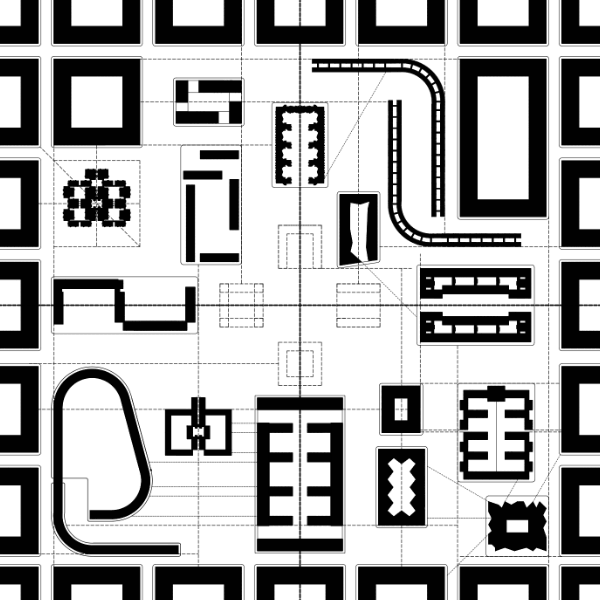
Cover image by students Ahn, González, Hernández, Peppa
Workshop Leader: Juan Herreros
Workshop Assistant: Pedro Pitarch
Date: 17th to 23Th of Oct.

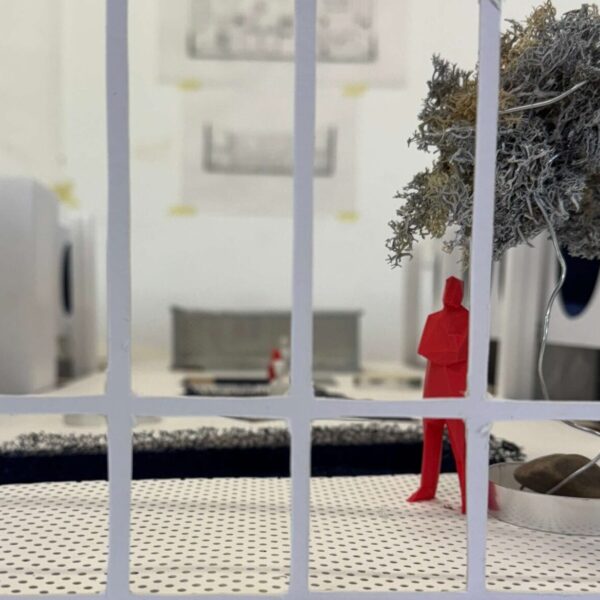
Image by students Chauhan, Izquierdo, Kaloudis, Maestre
The city, a utopia in perpetual reconstruction, is today undermined by its own worst ambitions: ruthless gentrification, the erosion of identities, growing inequality, and the fabrication of artificial scenarios that fuel irresponsible consumerism. In recent years, it has also become the epicenter of two global crises that intersect with particular force in urban environments: the urgent need for accessible housing and the accelerating degradation of ecosystems, now pushed to the brink of irreversible imbalance.
The reckless pursuit of agendas that ignore the planet’s future has unleashed a worldwide chain reaction, exacerbating alarming phenomena such as the impoverishment of entire populations, the abandonment of rural territories, mass migration, and persistent inequalities that should concern us all. These challenges can no longer be dismissed as “someone else’s problem.” Increasingly, not only low-income groups but also young people, single-person households, older adults, and many others find themselves pushed aside by a market that favors only the most profitable profiles. These dynamics place pressure on public administrations to enact social policies that often exceed their capacity for meaningful response.
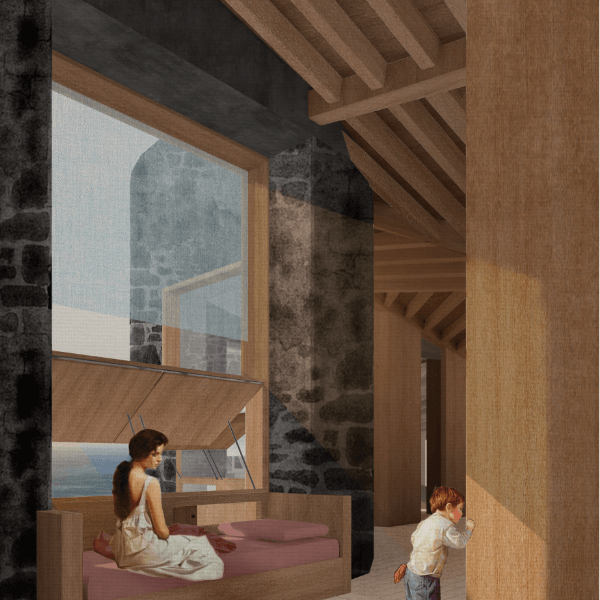
 Image by students Chauhan, Izquierdo, Kaloudis, Maestre
Buildings to Be Re-Occupied
In the chaotic urban landscape—shaken by a crisis of models and overwhelmed by unprecedented demands—opportunity becomes visible only to the most attentive architects. Anonymous spaces, buildings severed from their original functions, rapidly changing urban fabrics, and abandoned structures form a unique environment that compels us to rethink what it means to recycle, preserve, and renovate. While common sense points toward repurposing what already exists, it is equally important to explore less obvious potentials, particularly through project-based research.
Across contemporary cities, countless obsolete structures—once symbols of progress—have remained unused for decades. Rather than demolishing them, we should envision their reactivation and post-occupation. Shifts in lifestyles driven by environmental urgency, remote work, and the growing relevance of the “15-minute city” underscore the importance of this approach. Simultaneously, new forms of coexistence, expanded cultures of care, and increasing attention to biodiversity and nature-integrated architecture demand residential environments that coexist harmoniously with a living, biodiverse urban realm.
Today, theories and practices of post-occupation are central to architectural innovation. In countries such as Germany and the United States, more than half of new projects involve the reuse of existing buildings; in Finland, the figure reaches 70%. This shift is redefining construction systems, energy use, regulatory frameworks, and the relationship between programs and architectural typologies. It challenges the traditional idea of the “ideal project”—a new, mono-functional, immutable structure—and positions adaptive reuse as the most relevant field of contemporary architectural practice.

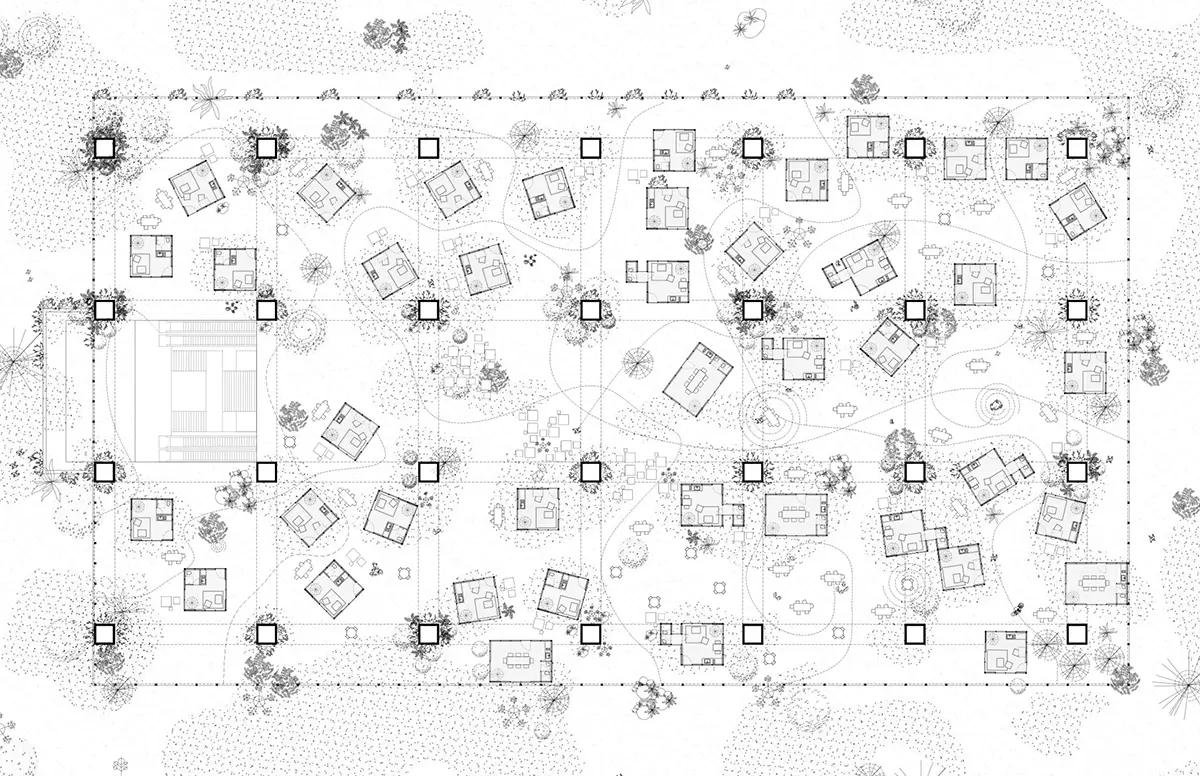
Image by students Chauhan, Izquierdo, Kaloudis, Maestre
The Project: Typological Corrections and Circular Economies
We explored the possibility of transforming large, abandoned buildings into biodiverse residential complexes. Their sheer scale provided extraordinary opportunities—not only for architectural and programmatic transformation but also for meaningful urban impact, improving and rebalancing their surroundings.
The resulting hybrids integrated innovative technologies, elements that interacted with natural and energetic systems, artificial ecologies, and new forms of connection among inhabitants. These architectures fostered hybridizations between old and new across structural, material, social, and functional dimensions, generating conditions that encouraged novel programs, economies, politics, and communities.
Our work spanned multiple scales, including the housing unit, exploring its specificities and possibilities in terms of program, boundaries, materials, reconfiguration, typology, and internal dynamics. We considered diverse forms of living: from minimal to expansive units, individual to collective models, and permanent to temporary arrangements.
The studio focused on three critical themes for addressing contemporary challenges:
· Recycling the existing city through typological corrections.
· Redefining ways of living through re-occupation.
· Exploring architecture as a tool for environmental activation through urban naturalization.
We aimed to form architects committed to human needs, resisting the allure of empty singularity. We positioned ourselves as professionals capable of diagnosing unexpected potentials in urban residential structures. Above all, we trusted in architecture’s ability to embrace indeterminacy and respond to future contingencies through thoughtful, responsible design.
About Juan Herreros.
About Pedro Pitarch.
Author: Camilo Meneses. MCH Manager