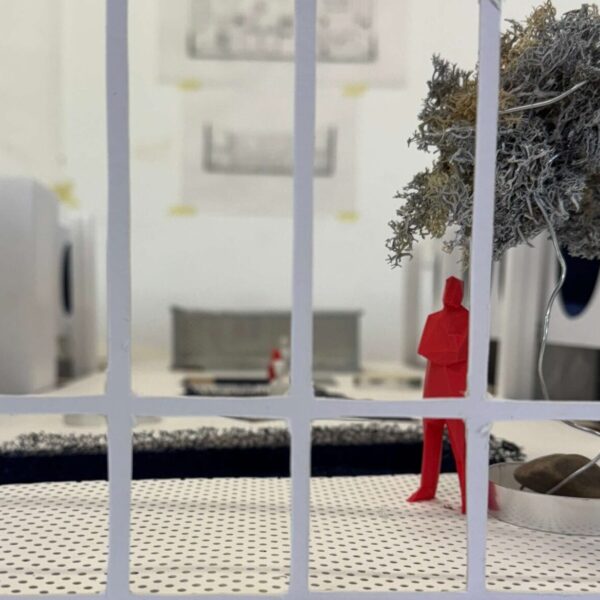
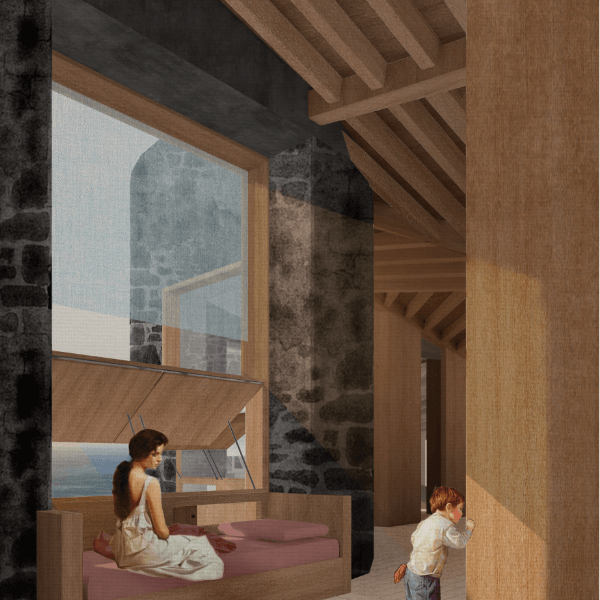
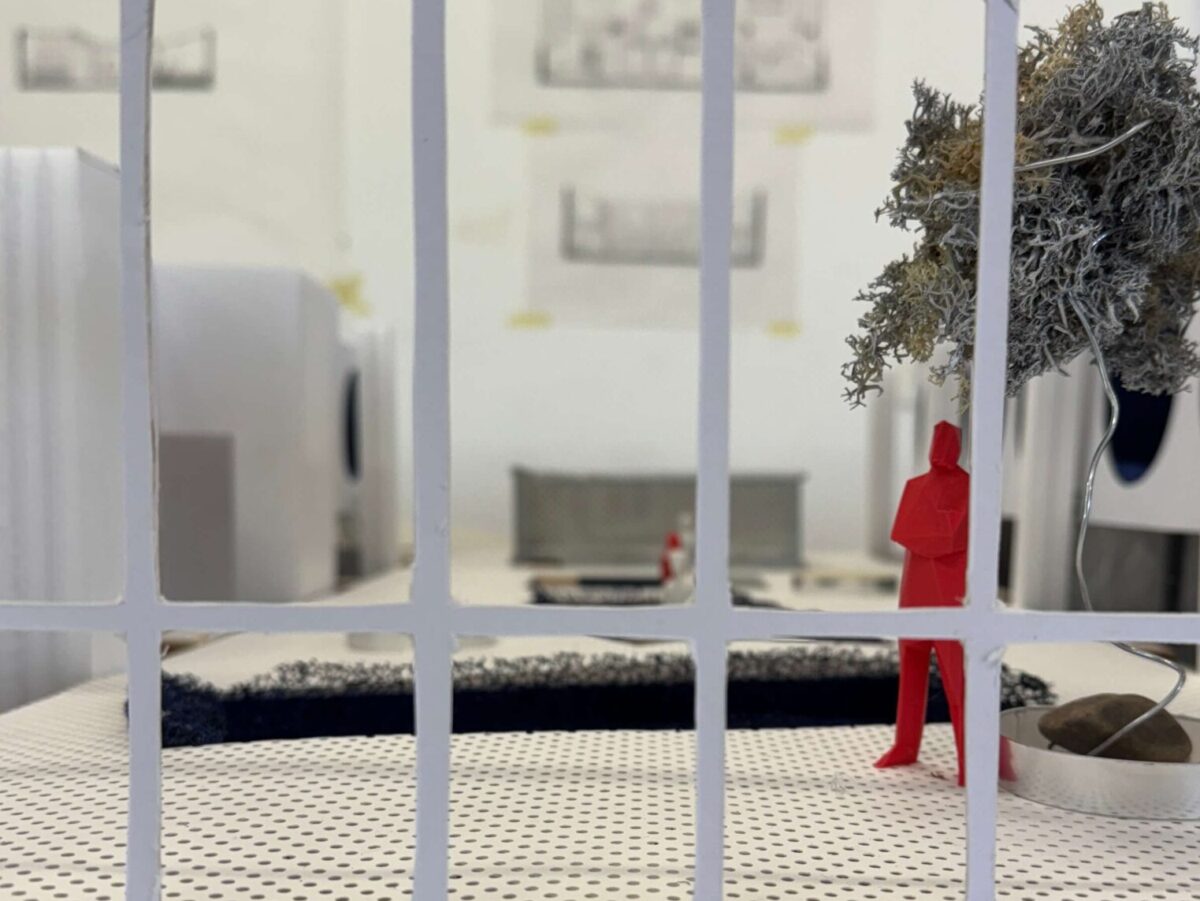
Cover image by students Guerra, Petersen, Sarango
Workshop Leader: Momoyo Kaijima
Workshop Assistant: Alberto Nicolau
Learning from Tokyo 3: Minimum, Floor, Window
The urban centres of Europe’s main cities are under relentless real estate pressure. Accelerating gentrification pushes the middle classes towards increasingly peripheral districts, and in Madrid access to central housing has become almost impossible for young people. Learning from Tokyo 3 confronts this condition through two essential questions: a theme, the search for alternatives to traditional residential types, and a method, a return to the tactile process of model-making and hand drawing.
News from the Future
Originality is often regarded as the fundamental quality of architectural design, understood as the search for the unknown and the unseen. Yet the most relevant projects in history tend to be reinterpretations rather than inventions, and novelty cannot be achieved without knowledge of the past, both distant and immediate.
Within this framework, Japanese cities offer a unique field of observation. Their relationship with tradition, radically different from the European one, keeps them in a constant cycle of construction and reconstruction. Tokyo has thus become a large-scale laboratory for new housing types, models that will sooner or later reach the old continent. Looking at Japan today is, in a sense, exploring the future of the European city.
Densification Without Demolition
The workshop challenges the assumption that increasing urban population requires replacing the existing building stock. Students were asked to transform a former industrial building at Calle de Ulises 95, in Madrid’s Canillas district, into collective housing, beginning with the definition of a specific inhabitant profile.
Each group developed a different floor of the same building. The outcomes diverged radically, showing the capacity of a single existing structure to hold multiple and simultaneous ways of living.
Three Keys from Tokyo
The design process is structured around three keys drawn from Tokyo’s domestic culture.
MINIMUM questions the conventional standards of dwelling size. While the average living area per person in Tokyo is 25 m², it falls to 15–20 m² in the 23 central wards. Working within this range forces a precise definition of what is essential to private life and what can be shared.
FLOOR reconsiders the ground as an inhabitable surface. Where the European house is organised by placing furniture within rooms, the traditional Japanese house rests on a raised floor of 30 to 45 cm, on which people sit, eat and sleep. The floor itself becomes furniture, an idea later expanded by Atelier Bow-Wow into three-dimensional configurations such as the skipped floor.
WINDOW addresses the relationship with the outside. In a climate of four distinct seasons, the window acts as an environmental regulator, and in high-density contexts it becomes the key element in producing openness and new relationships with neighbours and the street.
2026 Methodological Focus: The Hand-Made Project
A defining feature of this workshop is the complete absence of the computer. All work was produced by hand, from a 1:20 model of the proposal to a series of plans, sections and details that allow an in-depth understanding of the project.
This way of designing connects the mind to a more tactile approach to architecture. The 1:20 scale brings the proposal into immediate proximity with its user. Beds, shelves, steps and curtains cease to be abstract symbols and become objects of daily use, defined with the same precision as the structure that contains them. The project is thus driven by one persistent question: how will people actually live in these spaces?
The intensive five-day format was structured around five review sessions, complemented by lectures from Momoyo Kaijima and Alberto Nicolau that enriched the students’ work. The workshop concluded with a presentation of the projects to an independent jury.